
TRAIN THE MIND. READ THE ENVIRONMENT. CONTROL THE RESPONSE.
REALITY BASED SELF-DEFENSE TRAINING AT PIMPLE SAUDAGAR -PUNE

REALITY BASED SELF-DEFENSE TRAINING AT PIMPLE SAUDAGAR -PUNE

But what happens when the situation is sudden, chaotic, uncomfortable or completely different from what you expected?
That's the gap KALAH training is designed to expose.
YOU DON'T HAVE TO ARRIVE FEARLESS, AGGRESSIVE OR PHYSICALLY CAPABLE. YOU ARRIVE WILLING TO LEARN; WE BUILD CAPABILITY PROGRESSIVELY.


Real-world safety requires more than physical skills. It requires awareness, emotional regulation and the ability to pause before reacting.
We train people to recognise stress, regulate themselves, make deliberate decisions and return to a calm state after pressure.


Self-defense is the vehicle through which we develop something bigger.

AWARENESS
See. Notice. Understand.
SELF-REGULATION
Stay calm. Stay present.
DECISION
Think. Choose. Act deliberately.
CAPABILITY
Develop the ability to execute.
CHARACTER
Use your capability responsibly.
What we practise in the training space should make us better human beings outside it.
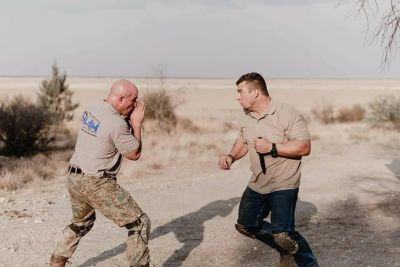
KALAH is built for people who want specialised self-protection training—not another fitness class or martial arts hobby.
Training is conducted in a focused environment where coaching quality, progressive development and individual attention matter more than class size.
We don't add techniques just to make training look impressive. Every drill, progression and training method has a purpose.
KALAH is a first generation taught, Israeli Special Forces, hand-to-hand combat system.
It is the result of a combination of the original, refined form of special forces Krav Maga and the realistically effective, battle tested form developed by Idan Abolnik.
Developing the ability to stay aware, calm and capable when things don't go according to plan.
Self-protection gives us a practical environment to develop awareness, composure, decision-making, physical capability and character.
We use self-defense as a vehicle for human development.

You want practical self-protection training that develops awareness, confidence and composure — not just another fitness class.

You want yourself or your teenager to become more aware, confident and capable of making better decisions under pressure.

You want practical self-protection training that develops awareness, boundaries, confidence and the ability to respond under pressure.

You don't need a martial arts background. You need willingness to learn and train consistently.

You don't want entertainment or choreographed demonstrations. You want progressive training that challenges your ability to adapt.
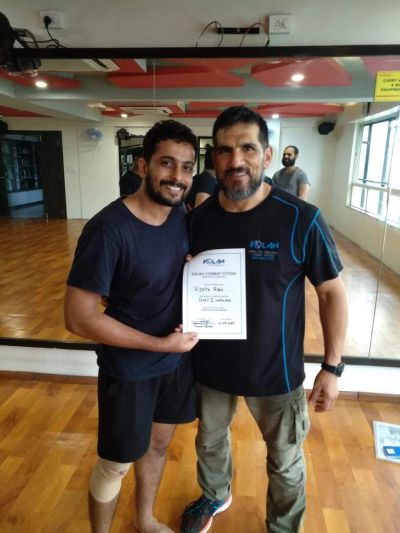
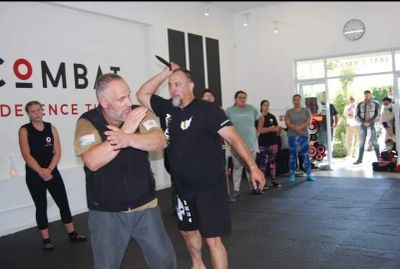
You are not training in a large commercial gym where self-protection is simply another class on the timetable.
KALAH training takes place in a dedicated training environment designed for focused practice, partner work, close-quarter training and progressive pressure.
The objective is simple: better coaching, better practice and better development—not bigger classes.
KALAH is not designed for people looking for a quick fix, flashy techniques or a way to prove how tough they are.
It is for people willing to train consistently, learn progressively and develop real capability over time.
Training becomes more challenging as your capability develops.
You don't need to arrive aggressive, fearless or physically capable.
You need to arrive willing to learn.
IF YOU WANT ENTERTAINMENT, THERE ARE EASIER PLACES TO FIND IT.

A dedicated training environment in Pimple Saudagar, Pune.
A focused space for group, semi-private and private training—built around practical training, partner work, progressive resistance and close-quarter development.
Please reach us at 78927 65374 or mail us at : kalahcombatsystemindia@gmail.com if you cannot find an answer to your question.
No, and we won't pretend otherwise. We show you the reality of an attack and train prevention, avoidance, de-escalation and escape. If everything fails, you are surviving, not winning, and the outcome is never guaranteed.
Training improves your options and your will to survive.
KALAH has roots in the Krav Maga lineage, but it is its own system. Many programs rely on fixed techniques. KALAH emphasizes principles, adaptability and pressure, and tests them against resistance, fatigue and uncertainty.
KALAH isn't built around collecting techniques.
We repeat and refine a small number of core principles, because simple principles hold up under pressure and long lists of moves don't. You progressively experience different positions, resistance, uncertainty and fatigue.
The value is in coaching, correction, repetition and progressive pressure. You can watch techniques online, but watching is not training.
No. Self-protection is the context, and human development is the purpose. Training builds awareness, self-regulation, decision-making, physical capability and character. The physical training builds capability, pressure builds composure, uncertainty builds adaptability, and discipline builds consistency. These qualities help in everyday life, not only in a confrontation.
Self-protection is not about looking for fights.
Our approach begins with prevention, awareness, avoidance, de-escalation and escape.
Physical protection becomes relevant when those options are no longer available and an immediate threat remains.
We therefore train both sides: how to avoid unnecessary confrontation and how to develop the capability to function when avoidance is no longer possible.
No. Physical self-protection is one part of a larger approach to human development.
We also focus on awareness, emotional self-regulation, decision-making, discipline, resilience and responsible behaviour.
The objective is to develop people who can recognise what's happening, manage their response, choose their actions wisely and adapt to life's challenges.
The goal is not simply to become someone who can fight. It's to become someone who knows when to act, when to step away and how to respond appropriately.
Self-defense doesn't always happen in levels. A real situation doesn't become “beginner” or “advanced” depending on the attacker.
The principles remain the same: awareness, prevention, avoidance, de-escalation, escape and protection.
What changes in training is the intensity, resistance, complexity and pressure. We start progressively and increase the challenge as the student becomes ready.
Fees may change, so confirm on WhatsApp when you enquire.
Pressure doesn't simply mean training harder or hitting harder.
It can involve resistance, fatigue, uncertainty, restricted movement, changing situations, decision-making and having to respond when things don't happen exactly as expected.
We progress from:
Understanding → Controlled Practice → Resistance → Pressure → Scenario-Based Training
The objective is to develop capability under realistic conditions while keeping the training progressive, purposeful and controlled.
Realistic does not mean reckless.
Because you will not always have the ideal position, space, time or conditions.
Training from disadvantage helps develop the ability to stay functional when your position is compromised, movement is restricted or the situation changes unexpectedly.
The objective isn't to make training unnecessarily difficult.
It is to progressively develop the ability to adapt when things don't go according to plan.
Close-quarter training deals with situations where there is very little space or time to react and normal movement options may be restricted.
Training can involve close-range striking, grabs and control situations, compromised positions, restricted movement, ground situations and scenario-based training.
The focus is not on memorising a sequence.
It is on developing awareness, composure, physical capability, control and adaptability when distance and options are limited.
Close-quarter training is not designed to make training look tougher. It is designed to develop capability where movement, time and options are limited.
Because avoidance is not always completely within your control.
Our training begins with awareness, prevention, distance management, de-escalation and escape. These are always the preferred options. But real situations can develop unexpectedly, and sometimes distance has already collapsed, attempts to de-escalate have failed, or there is no clear escape route.
That is why we also train close-quarter situations.
The purpose is not to teach people to look for fights or to believe they can “win” against an attacker. It is to develop the ability to stay functional under pressure, apply simple principles, create an opportunity to disengage, and get yourself and others to safety when safer options are no longer available.
The closer the situation gets, the more important your awareness, composure, decision-making and physical capability become.
That is where KALAH training comes in.
Scenario-based training moves beyond rehearsing a fixed technique against a predictable attack.
The situation can change. The environment can change. The person's response can change. Your position can change.
You have to observe, make decisions, adapt and respond.
The goal is not to create a perfectly choreographed demonstration.
The goal is to train for uncertainty.
Because self-defense is not about collecting techniques. It is about developing the ability to use simple principles when you are under pressure. We deliberately repeat and refine a small number of core principles rather than constantly adding new techniques. The value is in the coaching, correction, repetition, resistance and progressive pressure—not simply knowing what to do. You can watch techniques online, but watching is not the same as training. Our job is to help you turn knowledge into capability.
Semi-Private Training is limited to 2–4 people and allows for more focused coaching, correction, repetition and progressive resistance.
Private Training is one-to-one and allows the training to be built much more closely around the individual's capability, goals, pace and progression.
The difference is primarily the level of individualisation and training environment, not simply the amount of training.
Yes.
A smaller training environment allows greater control over the pace, repetitions, resistance, complexity and progression.
This can be particularly useful for someone who wants to work progressively toward higher-pressure, more complex or more specialised training.
The training is still controlled and progressive. More intensity does not automatically mean better training.
The objective is to develop greater capability while maintaining the quality and purpose of the training.
Smaller training environments allow us to give more individual attention and control the progression more closely.
This means more focused coaching, more repetitions, more specific correction and the ability to progressively increase resistance and complexity according to the individual.
You're not simply paying for a smaller class.
You're paying for a more individualised training process.
Yes. As training progresses, resistance, contact, complexity and pressure can increase, so physical risk cannot be completely eliminated.
Training is introduced progressively and controlled according to the student's capability and readiness.
We do not believe that unnecessary injury or excessive aggression makes training more realistic. (Remember we use all safety measure like: gear, stop signals, medical disclosure).
Realism and recklessness are not the same thing.
Real-world confrontations don't come with a referee saying, “Go.” There is usually no clear starting point. A situation can develop through words, body language, distance and escalating behaviour, and you may not know exactly when it is going to become physical.
That is why KALAH training starts with everything before the physical confrontation. We focus on awareness, distance management, prevention, negotiation, de-escalation, controlled communication and non-confrontational body language.
The objective is always to create an opportunity to disengage and allow the situation to calm down.
The physical training comes when those options have failed.
When distance management has failed, when attempts to de-escalate or negotiate have failed, when you have tried to disengage and the other person continues to create an immediate physical threat—this is where KALAH's close-quarter training becomes relevant.
At that point, you need to be able to function under pressure and protect yourself or someone with you.
But there is another important part: knowing when to stop. Self-protection is not about winning a fight or continuing once the immediate threat has ended. You need the awareness and judgement to recognise when the danger has passed and return to safety.
We therefore train both sides of the equation: how to avoid physical confrontation—and how to respond when avoidance is no longer possible.
Prevent when you can.
De-escalate when you can.
Escape when you can.
Protect when you must.
Stop when the threat is over.
That's the essence of our approach.
Yes, at the level of awareness and response. The first rule is to avoid the situation, hand over property if that is all that is demanded, and escape.
We train recognizing weapon threats and responding when there is no safe alternative. Weapons make any situation more dangerous, and no training can guarantee an outcome.
No.
KALAH training is not about proving toughness or constantly training at maximum intensity.
Training becomes progressively more demanding as your capability develops.
If you are looking for aggressive training from Day 1, this may not be the right starting point.
If you are willing to learn, adapt and develop consistently, we can progressively build your capability.
Our instructor courses are very demanding, while student training builds step by step.
And the person you become through training should be capable not only in a difficult situation, but in life.
We value:
Discipline • Responsibility • Respect • Courage • Integrity • Humility • Empathy • Self-Respect • Service • Wisdom • Contribution
These values are not limited to the training floor.
They should influence how we behave with our family, our colleagues, our training partners, our community—and when nobody is watching.
Capability without character becomes ego.
Capability with character becomes responsibility.
Beside Jeevan Jyoti hospital Rahatani, above satnam medicals & Wisdom laptops , Rahatani, Pune, Maharashtra, India
Copyright © 2026 Kalah System India - All Rights Reserved.

Hello! Thanks for visiting KALAH India. Have questions about our self-defense training, One on One training? Contact us directly on WhatsApp—we’re here to help.